Guides
Are Tattoos Haram in Islam? The Honest Answer (2026)
Are temporary tattoos haram or halal? What scholars actually say about permanent ink, what changes when nothing is injected and nothing lasts, and straight answers on wudu and prayer.
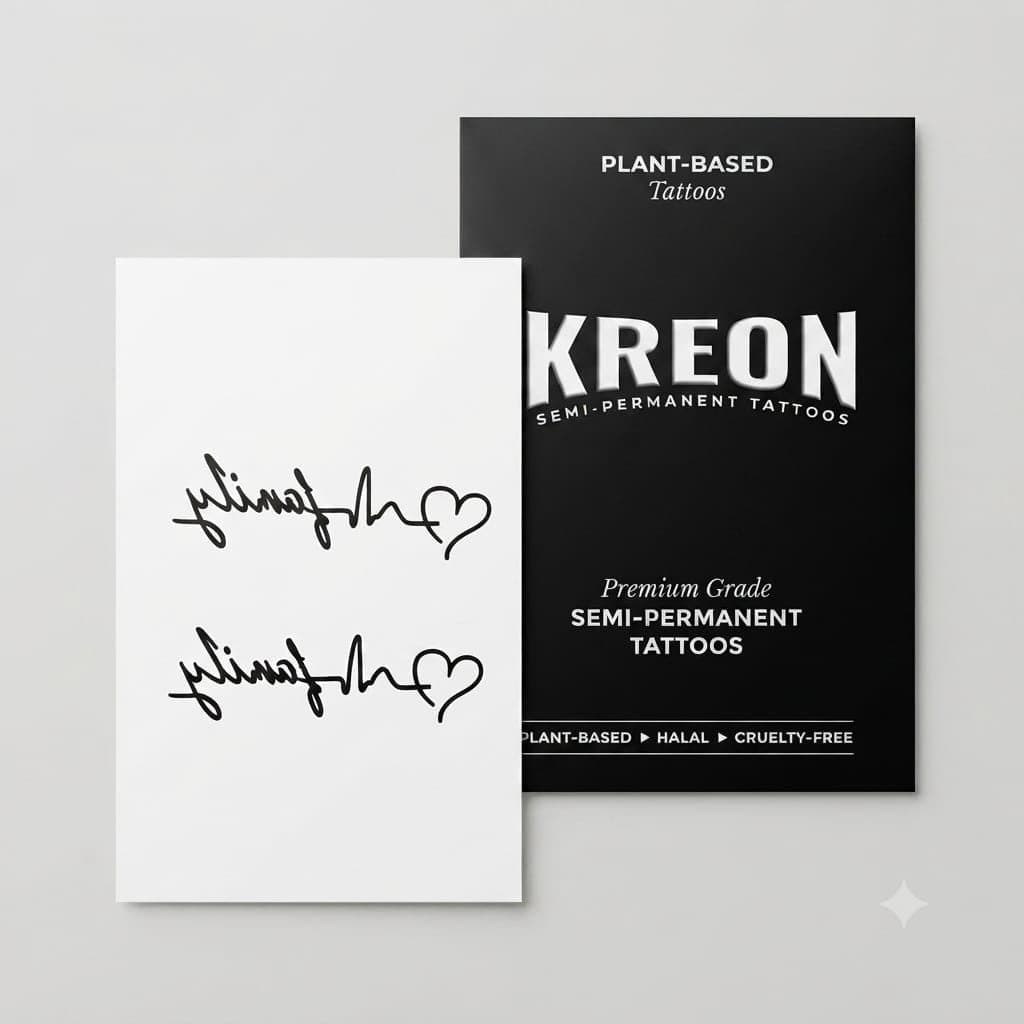
Let us start with the question most people are actually here for. When Pakistanis ask us about KREON, the first thing they ask is usually not the design and not the price. It is about deen. Is this haram? Is this like a real tattoo? Can I still pray?
So here is the complete, honest picture, written with respect. We are a tattoo company, not a darul ifta, and we will never issue a ruling. What we can do, and what this page does, is explain exactly what a semi-permanent tattoo physically is, lay out what scholars say about tattoos in Islam, and then leave the decision where it belongs: with you and the scholar you trust.
The short answer first
Permanent tattoos are considered haram by the majority of Islamic scholars, because they permanently alter the body. A temporary, plant-based stain that fades fully in about two weeks is treated very differently by many scholars, much like henna, provided the design itself carries nothing haram. Your own scholar has the final word.
Why most scholars say permanent tattoos are haram
When you hear "tattoos are haram", this is the body of evidence behind it, and it is worth understanding rather than just repeating:
- The Quran on altering creation. In Surah An-Nisa (4:119), Shaytan vows to mislead people, including commanding them to change the creation of Allah. Many scholars read permanent, unnecessary body alteration under this warning, and permanent tattooing is the classic modern example they give.
- The hadith on tattooing. Narrations recorded in Sahih al-Bukhari and Sahih Muslim, reported from Abdullah ibn Umar (RA), describe a strong curse on the woman who tattoos others and the one who gets tattooed. For most scholars across the four major schools, this settles permanent tattooing as prohibited.
- Permanent alteration of the body. A needle carries pigment below the skin, where it stays for life. That permanence, changing what Allah created without a medical need, sits at the heart of the ruling.
- Unnecessary pain and harm. Islamic law also weighs unnecessary harm to the self. A procedure done purely for decoration, involving pain, can fall under this principle for some scholars.
This is the mainstream position, and any honest guide has to present it plainly. If someone were thinking about a real, needle-and-ink permanent tattoo, this is what they would be weighing.
Why temporary and skin-stain tattoos are different
Now the part that changes the picture completely. The ruling above rests on what a permanent tattoo physically is: injected, permanent, painful. A semi-permanent skin stain shares none of that. Four factual pillars matter here:
- Nothing is injected. No needle ever touches the skin. A plant-based, jagua-style stain rests on the surface and colors only the top layer of skin, the layer that is already dead and constantly renewing.
- It fades fully in about two weeks. As your skin renews itself, the design leaves with it. There is no lasting alteration of the body, which is the exact thing the permanent-tattoo ruling is built on.
- Water still reaches the skin. The stain does not sit on top like a film or a sticker; it is inside that top layer. In wudu and ghusl, water reaches the skin as it always does.
- It is closest to henna. A plant-based color that sits in the top layer of skin and disappears as skin renews: that description is also the description of mehndi, which Muslims across our culture have worn for centuries with broad scholarly acceptance.
Conditions that make any tattoo permissible
Even with the physical side settled, scholars are clear that the design itself carries weight. Whatever you wear, temporary or not, the common-sense conditions are:
- No symbols of shirk. Nothing tied to the worship of other religions, no idols, nothing that mocks any faith.
- No indecent imagery. Nothing vulgar or inappropriate, whatever the design, wherever the placement.
- No immoral wording. Words and messages should stay clean. A beautiful script means nothing if what it says is wrong.
- Modesty respected. Placement and display should stay within the modesty you already keep in daily life.
Choose designs you would be comfortable being seen wearing in front of your family and your prayers, and you are on steady ground. That instinct is usually the right guide.
Can you pray and take wudu with it on?
Yes, and here is the simple reason. The worry some people have is whether the tattoo forms a layer that stops water from reaching the skin, which would affect wudu. A skin stain does not do that. It is not a coating over the skin; it is color inside the skin's top layer. Water in wudu and ghusl reaches your skin exactly as before, and nothing about your namaz changes. This is the mainstream understanding, and it is the same reason wudu with henna has never been a question. Our FAQ answers this and the other day-to-day questions in the same plain way.
What we believe at KREON
Our place in this conversation is small, and we keep it small. Every KREON tattoo is plant-based, needle-free, and fades fully, and we publish exactly what the product is and exactly how it works, nothing hidden. We chose this form of ink partly because it answers these questions honestly: no permanence, no injection, nothing between your skin and your wudu. The religious decision, though, does not belong to a brand. It belongs to you, your own understanding, and the scholar you trust. Browse the collections with that in mind, and pick only what sits right with you.
Straight answers to common questions
Is a semi-permanent tattoo haram like a permanent one?+
The ruling people quote targets permanent tattoos: injected ink that alters the body for life. A semi-permanent stain is needle-free and fades fully in about two weeks, so many scholars treat it as a separate question, closer to henna. The design conditions still apply, and your scholar's word comes first.
Does wudu count with a semi-permanent tattoo on?+
By mainstream understanding, yes. The stain is not a film over the skin; it colors the top layer itself, so water reaches the skin normally in wudu and ghusl. There is nothing blocking the water.
Is it basically like henna?+
That is the closest comparison. Both are plant-based colors that sit in the top, renewing layer of skin and disappear as the skin renews. Henna has been worn across Muslim cultures for centuries, which is why the comparison matters to many scholars.
Can I pray namaz with it on?+
Yes. A surface stain does not interfere with wudu or with prayer, and there is no ruling that blocks you from praying because of one. Your namaz is exactly your namaz, with or without it.
What if a scholar I follow still says no?+
Then follow the scholar you trust, without hesitation. A brand should never outrank your own taqwa. Our only job is to describe the product honestly, which this page does, and the rest is between you and the people whose knowledge you rely on.
If you have read this far, you approach decisions the right way: information first. If the picture above sits well with you and your scholar, see what a wudu-friendly tattoo actually feels like. The shop is one click away, how it works explains the stain in two minutes, and for anything personal we answer on WhatsApp within the hour, usually.